Health and Safety Policy for Cleaner Kentish Town
 This health and safety policy sets out the standards and practices expected in every cleaning task carried out by Cleaner Kentish Town. Our aim is to protect staff, clients, visitors, and anyone who may be affected by our work. We believe that safe working is not separate from good cleaning; it is part of the same professional service. Every cleaner is expected to follow safe systems of work, use equipment correctly, and report any concern before it becomes an incident.
We are committed to maintaining a workplace where hazards are identified early and controlled effectively. This includes routine risk assessment, appropriate training, supervision, and the use of suitable protective equipment. The policy applies to all cleaning activities, whether the task involves domestic interiors, shared spaces, specialist surfaces, or periodic deep-cleaning assignments. A safe approach protects people, property, and the quality of service.
 All workers must understand that cleaning health and safety is a shared responsibility. Managers are responsible for setting standards and making sure procedures are followed. Cleaners are responsible for working carefully, using equipment as instructed, and stopping work if a situation becomes unsafe. Clients also have a part to play by providing accurate information about site conditions, access issues, and any known risks.
Risk assessment is central to our approach. Before beginning work, we consider the layout of the premises, the condition of the floors, the presence of fragile items, electrical equipment, and any substances that may create a hazard. Particular attention is given to slips, trips, and falls, which remain among the most common risks in the cleaning sector. Wet floors, trailing cables, cluttered walkways, and poor lighting must be addressed promptly.
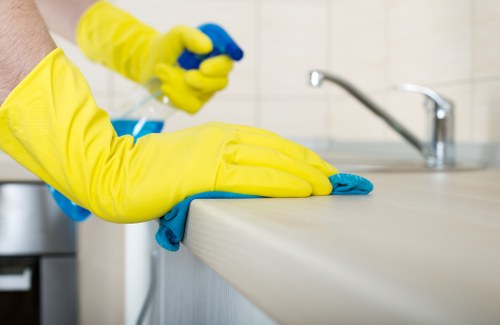
Personal protective equipment must be worn when required by the task. This may include gloves, aprons, eye protection, masks, or slip-resistant footwear. PPE should be kept clean, checked before use, and replaced when damaged or no longer effective. The correct equipment helps reduce exposure to chemicals, biological matter, sharp objects, and other hazards. However, PPE is only one control measure and must work alongside good technique and careful planning.
 Chemical safety is another key part of this policy. All cleaning products must be stored securely, labelled clearly, and used according to instructions. Products should never be mixed unless the manufacturer states it is safe to do so. Decanting into unmarked containers is not allowed. Staff must understand dilution rates, contact times, and the correct method for applying each product. When using stronger substances, ventilation should be maintained wherever possible.
Training and supervision support the consistent application of cleaner safety procedures. New staff receive induction covering safe handling, emergency action, equipment use, manual handling, and incident reporting. Refresher training may be provided when procedures change or when additional risks are identified. Supervisors may observe work practices and give corrective instruction where needed to maintain high standards.
Manual handling must be planned carefully to reduce strain and injury. Lifting, carrying, pushing, and pulling should be avoided where a safer alternative is available. Where lifting is unavoidable, cleaners should assess the weight, grip, and path in advance, then use stable posture and controlled movement. Team lifting should be used for awkward or heavy items. Equipment such as trolleys or carts should be loaded evenly and used on suitable surfaces.
Electrical safety is essential when using vacuum cleaners, floor machines, steam devices, or other powered tools. Cables and plugs should be inspected regularly, and damaged equipment must not be used. Machines should be switched off before cleaning, emptying, or adjusting. Staff must keep water away from live electrical parts and avoid overloading sockets. Any defect or unusual noise should be reported immediately.
 Emergency preparedness forms part of the policy. Staff must know how to respond to accidents, spills, fire alarms, chemical exposure, or injury. First aid arrangements should be available and accessible, and incident details must be recorded accurately. If an unsafe condition is discovered during a job, the work area should be made secure before cleaning continues. This may involve isolating the area, placing warning signs, or stopping the task until the risk is controlled.
Occupational health is also protected through reasonable scheduling, hydration, rest breaks, and attention to fatigue. Cleaning work can be physically demanding, so the workload should be organised to support safe performance rather than speed alone. Cleaner Kentish Town expects a professional standard of care that includes neat presentation, respectful conduct, and awareness of how actions affect others in the property.
To support long-term safety, equipment and procedures are reviewed regularly. Any recurring hazard, near miss, or pattern of concern is examined so controls can be improved. This continuous review helps strengthen our health and safety management and ensures the policy remains effective in practice.
 This policy is intended to create a safe, reliable, and responsible working environment for everyone involved in our cleaning services. By following clear procedures, using the right equipment, and remaining alert to risk, Cleaner Kentish Town can deliver consistent results while protecting people and property. Safety is not treated as an optional extra; it is an essential part of every clean, every day.